
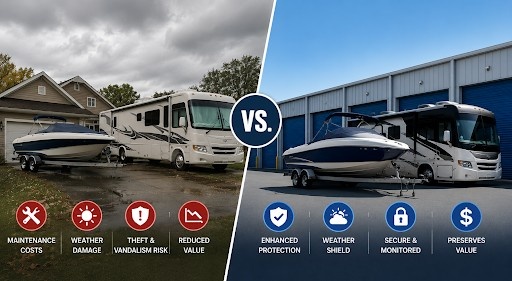
You just dropped seventy grands on a fiberglass wake boat or a shiny new fifth wheel. Now you need somewhere to park it.
You look at that empty slab of concrete next to your garage. You think it’s the ultimate storage solution. Why pay a monthly storage cost when you own the land? It makes perfect sense on paper. But it’s a trap.
The reality: storing your RV or boat at home is a massive financial drain disguised as a freebie. People try to save a few bucks by jamming a 30-foot rig onto their property, only to lose thousands in accelerated depreciation, municipal fines, and pest damage. Sure, utilizing that space at home seems like the default storage option . But the hidden costs?
Let’s break down exactly what you are paying for that “free” parking spot.
Look at it this way. You don’t actually own your driveway if you live in a deed-restricted community.
You might think you’re in the clear because you backed the camper behind the fence line. Think again. When you choose outdoor storage in a residential neighborhood, you are putting your wallet at the mercy of bored neighbors and aggressive Homeowner Associations. Even if you don’t have an HOA, most city ordinances strictly prohibit parking recreational vehicles on unpaved surfaces or blocking public rights-of-way. You’ll spend every other weekend shuffling vehicles around just to avoid a citation. Storing your RV legally at a residence is often practically impossible without pouring a massive, expensive concrete pad.
And then there’s the weather. UV rays absolutely murder fiberglass gelcoats and rubber roof seals.
You throw a cheap blue tarp over your boat and call it a day, right? Wrong. That tarp traps the humidity and bakes a nasty layer of black mildew right into your upholstery. Come spring and you’re going to spend about 20 hours scrubbing the seats with bleach instead of being on the water. A dedicated storage facility mitigates this. Even uncovered commercial boat storage facilities offer wide, angled parking that allows for proper breathability under heavy-duty canvas covers without the micro-climate issues of a cramped residential side-yard.
Worse still, your yard is a buffet for local wildlife.
When you park a rig on grass, gravel, or a suburban driveway for the long term, you are inviting nature inside. Modern engine wiring harnesses are heavily insulated with soy-based plastics. To a field mouse, your $3,000 engine harness is literally a snack.
Mud wasps build concrete-hard nests inside the exhaust vents of an RV propane heater. You go to turn on the furnace during a chilly October hunting trip, and the entire unit backs up with carbon monoxide. To reduce the risk of this kind of catastrophic damage, you need proper RV storage on treated, heavily trafficked commercial pavement where pest control is actively managed.
Let’s look at the actual numbers. The idea that you save money at home ignores the heavy toll of DIY maintenance and liability.

Because professional storage types exist on a spectrum (from open-air paved lots to fully enclosed, climate-controlled bays) you can pick exactly what fits your budget. But almost all of these storage spaces end up cheaper than replacing a chewed-up generator line or paying someone to restore oxidized fiberglass.
We have to talk about theft. A $20 hardware store padlock on your trailer hitch isn’t stopping a motivated thief.
Residential driveways are prime real estate for opportunistic crime. A guy with a battery-powered reciprocating saw can slide under your camper and remove your catalytic converter in under sixty seconds. At 3 AM, nobody is going to hear it. They will strip your lithium-ion house batteries and rip the expensive marine electronics right off your boat’s helm before your motion-sensor floodlight even registers them.
You want actual peace of mind? You need commercial-grade perimeter fencing. You need highly monitored gate access where every entry and exit is logged. Professional facilities design their parking spots specifically to limit blind spots, utilizing 24/7 high-definition surveillance that police can actually use. Your home Ring camera catching a blurry image of a guy in a hoodie doesn’t get your stolen gear back.

Stop treating your driveway like a junkyard and gambling with your investment. It is time to get that massive rig off your property, dodge the HOA fines, and put your asset somewhere that actually protects its value. Check out All Lakes Storage to find a secure, accessible spot that fits your rig perfectly. Go reclaim your garage space today.
Many insurance carriers offer significant premium discounts if you use a secure storage facility with gated access and surveillance, helping offset the monthly rental fees.
Moisture rises from the ground, rusting your chassis and rotting wood subfloors. It also creates a direct highway for field mice and insects to enter your rig.
Yes. You signed covenants granting the HOA power to enforce aesthetic rules. They can legally fine you daily or place a lien on your property for non-compliance.
Look for high perimeter fencing, digital keypad gate access, 24/7 high-definition video surveillance, and excellent nighttime lighting. On-site management is also a massive deterrent for thieves.


